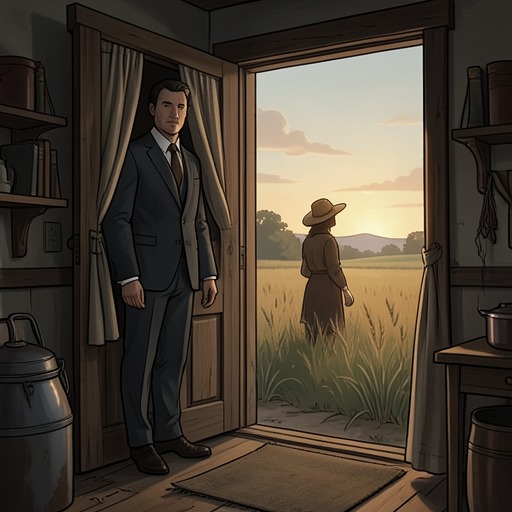
George Bigheart’s confidential relationship with W. W. Vaughan
Killers of the Flower MoonGeorge Bigheart’s confidential relationship with W. W. Vaughan began with a demand for trust: in June 1923, as Bigheart lay in an Oklahoma City hospital after suspected poisoning, he would discuss what he knew about the Osage murders only with Vaughan. Their meeting made Vaughan the recipient of information and incriminating documents, and it placed him in the path of the same violence that had silenced Bigheart.
The Call and the Trust
Vaughan, a fifty-four-year-old Pawhuska attorney and former prosecutor, had worked with private investigators trying to solve the Osage murders. He had vowed to eliminate the criminal element that preyed on people earning an honest living. In a county where many Osage believed local authorities were colluding with killers, that work carried unusual danger. Bigheart, forty-six, was a nephew of the legendary chief James Bigheart. A friend of the ailing man called Vaughan urgently: Bigheart had information about the murders but would speak only to someone he trusted. When Vaughan asked how serious Bigheart’s condition was, the answer was simply that he should hurry.
Before leaving for the hospital, Vaughan told his wife, who had recently given birth to their tenth child, where he had hidden evidence he had gathered about the murders. If anything happened to him, she was to retrieve it and give it to the authorities; he had also left money there for her and the children. The warning reveals the stakes Vaughan attached to his work before he knew what Bigheart would tell him. His confidence in Bigheart’s information was matched by an awareness that the evidence, and those carrying it, could be in danger.
At the hospital, Bigheart was still conscious. Other people were present, but he motioned for them to leave. He apparently then shared his information with Vaughan, including incriminating documents. Vaughan stayed beside him for several hours, until Bigheart was pronounced dead. The surviving account does not specify everything Bigheart disclosed or establish precisely what the documents contained; it does show that Vaughan left believing he had what he needed. He telephoned the new Osage County sheriff and said he was rushing back on the first train. When the sheriff asked whether he knew who had killed Bigheart, Vaughan replied that he knew more than that.
Disappearance and Murder
After Bigheart died, Vaughan called the new Osage County sheriff to say he had the information he needed and was hurrying back on the first train. The sheriff asked whether Vaughan knew who had killed Bigheart; Vaughan answered that he knew more than that. He then boarded an overnight train. The next day, when it arrived, Vaughan was missing. A Tulsa newspaper reported that his clothes had been left in the Pullman car, turning the disappearance into an immediate mystery.
The search drew in Pawhuska’s Boy Scouts, whose first American troop had been organized there in 1909, as well as bloodhounds tracking Vaughan’s scent. Thirty-six hours later, his body was found beside the railroad tracks, thirty miles north of Oklahoma City. He had been thrown from the train, his neck broken, and stripped virtually naked, as the oilman Barney McBride had been. The incriminating documents Bigheart had given Vaughan were gone; the hiding place Vaughan had described to his wife had also been emptied. The disappearance thus took both the evidence entrusted to Vaughan and the material he had independently collected out of reach.
At the inquest, a prosecutor asked the justice of the peace whether Vaughan had known too much. The justice answered that he had, and that he had valuable papers on him. That judgment captured the force of the sequence without resolving who killed Vaughan: Bigheart’s confidence had brought Vaughan to his hospital bedside, and the information he carried vanished with him. His death made the trust between the two men consequential beyond their private meeting, while leaving the murder and the loss of the papers as questions the investigation had not answered.
The Evidence Left Behind and the Unanswered Case
The later record made clear that the hospital meeting was not an isolated exchange between two men: it sat within a wider network of suspected financial and criminal dealings. Vaughan’s family preserved thick binders of material about his death, including newspaper clippings, his death certificate, and an informant’s statement that Vaughan had said shortly before he was killed that he had gathered enough evidence to put William K. Hale in the electric chair. The surviving account does not disclose exactly what Bigheart told Vaughan or what the missing papers contained. It does establish why the loss mattered: Vaughan had been carrying information that could have implicated powerful figures, and the record that might have clarified its contents disappeared with him.
Archival research later brought H. G. Burt into both men’s stories. In secret grand-jury testimony from 1926, an insurance agent said Burt had recommended another Indigenous person as a target for an insurance-policy scheme. Separate Bureau of Investigation records described Burt and Hale as close associates and reported that they had shared money obtained from Bigheart. Hale had successfully claimed $6,000 from Bigheart’s estate using a bogus creditor’s note; the records left unclear what sum the phrase about sharing the proceeds referred to, and whether it included money Burt had tried to take. Bigheart’s estate, however, passed to his wife and young daughter, not to Hale or another white man. The distinction matters: the records raised suspicion without establishing that Hale or Burt inherited Bigheart’s fortune.
The daughter’s guardianship supplied a more direct financial connection. Her guardian was Burt, giving him control over money belonging to Bigheart’s child. The investigator’s retrospective account also gathered several other points of suspicion: government records showed Burt had served as guardian to other Osage, including someone who died; a local lawman noted that Burt and Hale had visited Bigheart shortly before his death; and court records showed Burt had taken money Bigheart intended for Vaughan, despite presenting himself as Vaughan’s close friend. These details do not prove who poisoned Bigheart or why, but they place Burt near the estate, the dying man, and the evidence Vaughan was trying to carry forward.
The link to Vaughan’s death was stronger than a mere association, yet remained short of a judicial finding. A newspaper account of Vaughan’s funeral reported that Burt had boarded the train with him in Oklahoma City and was aboard when Vaughan disappeared from his berth; another report said Burt himself had reported the disappearance. A Bureau informant who had been close to Hale and supplied evidence in other murder cases later said he thought Burt had killed Vaughan. The Fairfax town marshal’s interview notes likewise implicated Burt and described a local tough as helping throw Vaughan from the train. The marshal also said Burt had considered fleeing during the Bureau investigation in 1925; Burt moved to Kansas that year. Each item adds a connection, but the account stresses that the case rested on circumstantial evidence, and Burt could no longer answer the accusation.
That uncertainty returned to the Vaughan family decades later. When the accumulated research was shared with Martha Vaughan, the limits of what could be known were made explicit; she fell silent and then sobbed. Her family still lacked answers about who carried out the killing and whether Vaughan was dead before he struck the tracks. The inquest had listed the cause of death as unknown, and the missing papers had never restored the account Bigheart entrusted to Vaughan. Their relationship therefore survives in the record as both an act of confidence and a broken chain of evidence: Bigheart chose Vaughan to receive what he knew, and Vaughan’s disappearance left the substance of that trust—and the full responsibility for their deaths—unsettled.
The Limits of the Official Closure
The distinction between what the record suggested and what it proved remained central to the relationship’s meaning. After William K. Hale and his conspirators received life sentences, authorities treated the cases as closed, although the Bureau had not connected Hale to all twenty-four murders. The later account specifically asks who abducted Barney McBride in Washington, D.C., and who threw Vaughan from the train. It notes that Hale relied on others to carry out killings, but that there was no evidence his usual associates—including Bryan Burkhart, Asa Kirby, John Ramsey, and Kelsie Morrison—had followed McBride to the capital or accompanied Vaughan. The men who killed them appeared to have escaped punishment.
That gap prevents the surviving evidence about Bigheart and Vaughan from becoming a complete account of either death. Bigheart’s choice of Vaughan as the person he trusted is clear; the incriminating documents Vaughan carried, and the evidence he had collected separately, are not. The official closure could name convicted conspirators, but it could not restore the lost papers or establish who was responsible for Vaughan’s murder. Their connection consequently remains both unusually consequential and unresolved: it is documented through the confidence Bigheart placed in Vaughan, while the knowledge that passed between them was partly erased by violence.